


NREMT EMT EXAM PREP 2026
4.624.00 Reviews
App Specs
- Version
- 2.1.020
- Updated On
- License
- Free
- Downloads
- 10,000+
- Developer
- Prepia Inc
- Categories
- Education
- Platform
- Android
Screenshots
 Analysis by AppCompare
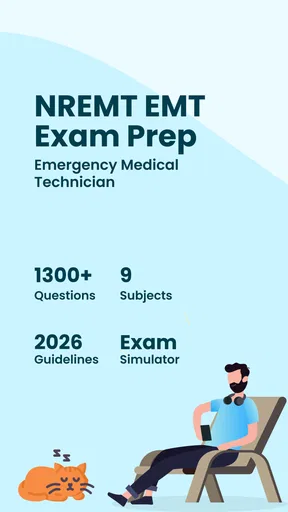
Preparing for the NREMT EMT exam can feel difficult because the challenge is not only remembering medical facts. You also need to recognize what a question is really asking, choose the safest first action, and stay calm when several answers seem reasonable. NREMT EMT EXAM PREP 2026 is an education app from Prepia Inc that focuses on that kind of exam practice rather than trying to replace every part of EMT training.
I found its main appeal in the directness of the study path. Instead of opening a broad medical reference and wondering where to begin, I could approach the app with one clear purpose: practice for the EMT exam through targeted questions and exam-style simulation. That makes it especially approachable for a first-time user who wants to turn a spare block of time into a focused study session.
The app is free to install and is suitable for Everyone, although it also offers in-app purchases ranging from around eight dollars to around sixty dollars per item. It requires Android 7.0 or later, and its current version is 2.1.020. On the store, it has an average rating of 4.6 from over two hundred ratings, with more than ten thousand installs. Those figures suggest a small but active study tool rather than a huge all-purpose learning platform.
Starting with the right expectations
The first thing I would tell a new user is not to treat this as a complete substitute for an EMT course, hands-on practice, instructor feedback, or official exam guidance. Its role is narrower and useful: it gives you a place to rehearse the kind of decisions and recall that exam questions demand. That distinction matters because a question bank can expose weak areas, but it cannot physically teach patient assessment or replace supervised clinical preparation.
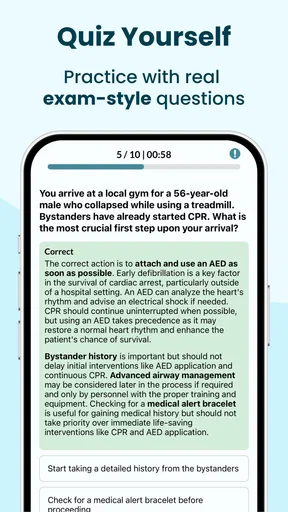
The store summary emphasizes targeted practice and exam simulators. In practical terms, that points to two different study modes. Targeted practice is better when I already know a subject is giving me trouble and want to work on it directly. A simulator is more valuable after I have reviewed the basics, because it tests whether I can apply them without stopping to choose only familiar topics.
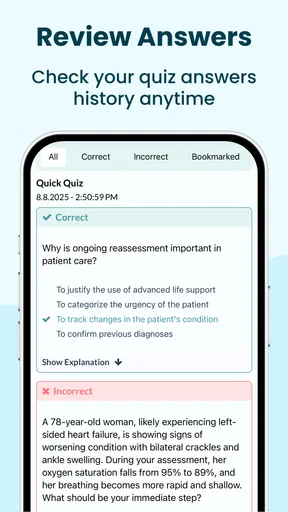
For a first session, I would avoid trying to “finish” the whole app. The more useful goal is to establish a repeatable routine: open a practice set, answer carefully, review the reasoning behind mistakes, and note the kind of error made. That last part is important. Missing a question because I forgot a fact is different from missing it because I rushed, ignored a key word, or selected an intervention before completing the initial assessment.
There is also a helpful psychological advantage to using a dedicated exam-prep app. A general search engine can produce endless explanations, videos, and flashcards, but that variety often creates decision fatigue. Here, the exam itself remains the organizing idea. I can spend less time choosing study material and more time seeing whether I can make a safe, defensible choice under pressure.
Worth Reading Before You Choose

Flipboard Shows What News Apps Must Do Beyond the Feed

Switching to Android Auto Means Rethinking Your Driving Routine

Google Calendar Makes a Crowded Week Easier to Manage

Ludo King Makes the Most of the Minutes Between Plans

Baby Panda World Brings Quick Play to Modern Phones, but Its Game Library Feels Busy

ESPN’s Live Game View Makes Following Close Games Easier
What a first-time user should prepare before opening it
I recommend having a notebook or a simple digital note ready before beginning. Do not use it to copy every explanation. Instead, create three small categories: knowledge gap, wording mistake, and priority mistake. This gives each wrong answer a useful destination. After several sessions, the pattern can tell you whether you need content review, slower reading, or more practice with scene and patient priorities.
A quiet ten-minute session is better than opening the app while distracted and tapping through questions just to maintain momentum. EMT exam questions often reward careful prioritization, so your study method should model that behavior. Read the complete question, identify the patient situation, decide what must happen first, and only then compare the options.
I would also keep your main EMT textbook or class notes nearby, not because the app is unusable alone, but because practice questions are most helpful when they lead to a precise review. If a question exposes uncertainty about a clinical concept, write down the topic and verify it in your course material. That workflow prevents a practice answer from becoming an isolated fact that you memorize without understanding.
From installation to the first meaningful success
After installing the app, my suggested first move is simple: begin with a manageable practice activity instead of jumping immediately into a long simulated exam. The purpose of the first attempt is to learn how the questions feel, how explanations are presented, and how easily you can identify your own weak points. A short, deliberate start is less intimidating and gives you information that a rushed full test cannot.
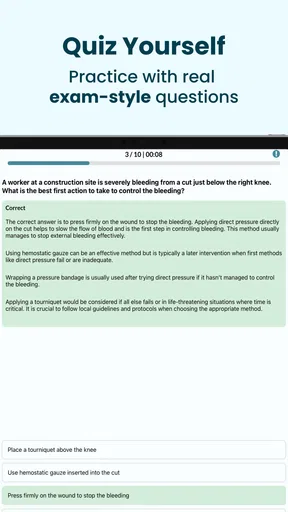
When answering, I use a three-pass reading habit. On the first pass, I identify the emergency or patient condition. On the second, I look for details that change priority, such as the immediate threat or the stage of assessment. On the third, I read the answer choices as actions, asking which one is appropriate now rather than which one might eventually be useful.
That approach is particularly valuable for EMT preparation because many distractors are not absurd. They may describe an intervention that belongs later, an assessment that is important but not first, or a treatment that would make sense in a different presentation. The app becomes more useful when I explain to myself why an option is premature, not merely why the selected answer is correct.
A first successful action should therefore be more than getting one question right. It should be completing a small set and being able to explain at least one decision in your own words. For example, after answering, ask yourself: what information controlled the priority, what alternative was tempting, and what would I need to reassess after acting? That turns passive quiz activity into exam reasoning practice.
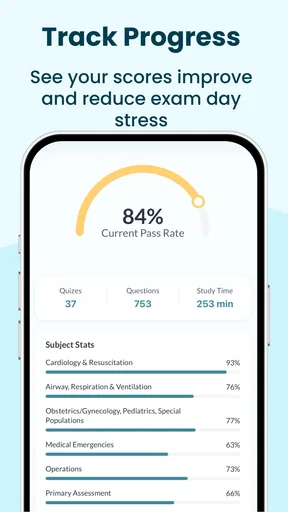
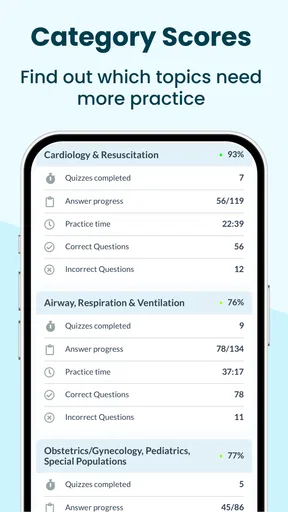
If your first result is disappointing, I would not interpret it as a prediction of your final exam performance. Early results are diagnostic. They show where your current recall and decision-making need work. Save the topics that caused hesitation, then return to them after reviewing your course material. The app is most effective as a feedback loop, not as a scoreboard that determines your confidence.
A practical routine for busy EMT students
For a student balancing classes, work, or family responsibilities, I would divide study into three types of sessions. Use a short targeted session when you have limited time and already know the topic to revisit. Use a longer mixed session when you want to practice switching between subjects. Reserve an exam simulator for a period when you can concentrate and review the result afterward.
One realistic routine would be using a short session during a commute break, provided you are not driving or responsible for patient care at that moment. Later, at home, review only the questions that caused uncertainty. On a separate day, attempt a mixed or simulated session without looking at notes. This spacing is more useful than repeating the same comfortable topic until every answer feels familiar.
Another useful trick is to answer before looking for reassurance from memory aids. If you immediately consult a textbook or online explanation, you may recognize the correct answer without proving that you can retrieve it independently. Let the app reveal your first response, then investigate the reason behind it. That makes the record of your mistakes more honest and your later improvement easier to measure.
Where new users may get confused
The most common confusion with exam-prep apps is assuming that a correct answer always means the underlying topic is mastered. It may only mean that the wording was familiar. I avoid that trap by changing the question after answering: could I explain the priority if the patient detail were slightly different? If not, I mark the topic for deeper review instead of counting it as fully learned.
Another point of friction is the difference between studying content and studying test behavior. Reading explanations can feel productive, but the exam also tests whether you can identify the best next step. When two choices both appear medically reasonable, focus on sequence, urgency, and scope. The right answer is often the action that addresses the immediate threat or gathers necessary information before a later intervention.
It is also easy to overuse simulation mode. A simulated exam can show how you perform when topics are mixed, but it is not always the best tool for learning a subject for the first time. If you are repeatedly missing questions about one area, switch back to targeted practice and review the concept. Returning to simulation without repairing the gap usually produces frustration rather than progress.
The purchase model deserves attention as well. The app is free to install, but optional items cost from around eight dollars to around sixty dollars each. I would begin with the accessible material and decide whether the workflow genuinely helps before paying for anything. A paid item may be worthwhile for someone who uses the app consistently and wants more structured practice, but it is not automatically a better investment than a strong textbook, instructor-led review, or official preparation resource.
That comparison is important. Flashcards are often better for rapid recall of terminology, while a textbook is better for building a complete explanation from first principles. A classroom or study group can correct misunderstandings that a question bank may leave untouched. This app sits between those options: more exam-focused than a general reference, but less comprehensive and interactive than a full course.
I would also avoid assuming that a high practice result proves readiness. Exam readiness includes consistent performance, understanding why answers are correct, and being able to handle unfamiliar wording. If I can only succeed when questions appear in a predictable order or when I remember a familiar phrase, I still need mixed practice and deeper review.
Who will benefit most from this app
NREMT EMT EXAM PREP 2026 is a strong fit for an EMT student who already has access to foundational instruction and wants additional question practice. It is especially useful for someone who needs a clear starting point, dislikes searching across unrelated resources, or wants to rehearse exam decisions in short sessions.
It can also help a learner returning to EMT material after a gap. Instead of rereading everything from the beginning, you can use practice to identify which areas remain available from memory and which need rebuilding. That makes review more efficient, particularly when your schedule does not allow long study blocks.
I would be more cautious about recommending it as the only resource for a complete beginner. If you have not yet learned the underlying assessment process, terminology, and treatment principles, answering questions alone may encourage memorization without safe understanding. In that situation, pair the app with formal instruction and use each missed question as a prompt to study the concept properly.
It may also be a poor match for someone who wants extensive video teaching, detailed textbook-style chapters, or direct instructor conversation inside the same product. Its value is concentrated in practice. If your preferred learning style depends on watching demonstrations or discussing complex cases step by step, another resource should carry that part of your preparation.
Turning practice into a next step
Once you have completed several sessions, do not simply repeat the same activity. Build a small review cycle. First, collect the topics behind your mistakes. Next, revisit those topics in your trusted course materials. Then return to the app and test yourself without notes. Finally, use a mixed session to check whether the improvement survives when the subject is no longer announced in advance.
One of the most useful trade-offs is deciding when to stop practicing a topic. If you keep answering familiar questions correctly, the activity may become comfortable without becoming challenging. Move on when you can explain the reasoning, then come back later under mixed conditions. The goal is flexible recall, not a perfect memory of one particular question sequence.
For exam-style questions, I recommend writing a one-line reason for every uncertain answer, even when it turns out to be correct. “I chose this because it addresses the immediate threat” is more valuable than “I remembered the option.” This habit exposes lucky guesses and helps you recognize whether your reasoning matches EMT priorities.
Use simulation as a checkpoint rather than a daily punishment. Before starting, remove notes and distractions. During the attempt, follow the same assessment order you would use in training. Afterward, review errors in groups: missed knowledge, poor prioritization, careless reading, and uncertainty between two plausible choices. Each group calls for a different correction, so treating every mistake identically wastes study time.
Because the app is free to install and supports Android 7.0 or later, it is easy to try without committing to a large study purchase at the outset. Still, I would make the decision based on your actual routine. If you open it regularly, learn from the explanations, and use the results to guide textbook review, optional paid material may have practical value. If you only tap through questions and forget them afterward, spending more will not fix the underlying method.
My overall view is positive but specific. This is a focused companion for NREMT EMT preparation, not a replacement for education, skills practice, or professional guidance. I like it most as a bridge between studying a topic and proving that I can apply it under exam-style pressure. The first meaningful win is not a perfect score; it is recognizing why an answer is the safest priority and carrying that reasoning into the next unfamiliar question.
If you are starting from zero, begin with your course foundation and use the app to reinforce it. If you already understand the material but need more disciplined practice, it is easier to recommend. Start small, review every uncertain response, compare weak areas with your main study resources, and progress from targeted questions to mixed simulation. Used that way, NREMT EMT EXAM PREP 2026 becomes a practical study companion rather than just another quiz app.
Pros
- Covers key EMT topics in a focused
- exam-oriented format.
- Practice questions help identify weak areas before test day.
- Short study sessions fit easily into busy schedules.
- Useful for reviewing terminology
- protocols
- and emergency procedures.
- Can support independent study without attending a prep course.
Cons
- Some content may not reflect the latest NREMT guideline changes.
- Practice questions may not fully match the real exam’s difficulty.
- Limited value if used without hands-on EMT training.
- Advanced features or full access may require an in-app purchase.
- Requires consistent self-discipline and may lack personalized feedback.
FAQs for NREMT EMT EXAM PREP 2026
What is NREMT EMT EXAM PREP 2026, and who is it designed for?
NREMT EMT EXAM PREP 2026 is a study app created for people preparing for the National Registry of Emergency Medical Technicians Emergency Medical Technician exam. It is mainly useful for EMT students, recent graduates, and candidates reviewing before test day. The app typically focuses on practice questions, explanations, topic-based revision, and simulated exams, but it should be used alongside an approved EMT course and official NREMT resources.
Does NREMT EMT EXAM PREP 2026 contain real NREMT exam questions?
Users should not assume that the app includes actual questions taken from the live NREMT examination. Most preparation applications provide original practice questions designed to reflect common topics, question styles, and difficulty levels. These exercises can help you identify weak areas and become comfortable with timed testing, but they cannot guarantee the same questions will appear on your exam. Always confirm current exam requirements through the official NREMT website.
Can this app replace an EMT course, instructor, or hands-on training?
No. NREMT EMT EXAM PREP 2026 should be treated as a revision and practice tool rather than a complete EMT education program. Passing the NREMT exam requires knowledge of patient assessment, airway management, trauma, medical emergencies, operations, and other subjects, as well as practical skills and clinical preparation. The app may support studying, but it cannot replace classroom instruction, supervised skills practice, clinical experience, or guidance from a qualified instructor.
Does NREMT EMT EXAM PREP 2026 work offline, and are all features free?
Offline access and pricing can depend on the version of the app, your device, and the developer’s current subscription model. Some study materials may be available without an internet connection after installation, while other features, such as progress synchronization, advertisements removal, premium question banks, or full mock exams, may require online access or payment. Check the Google Play Store or Apple App Store listing carefully before downloading and review any in-app purchase terms.
How should I use NREMT EMT EXAM PREP 2026 to prepare effectively?
For the best results, use the app as part of a structured study plan instead of simply repeating questions until you memorize answers. Begin with a diagnostic quiz, review explanations carefully, and record topics where you make repeated mistakes. Practice patient assessment and clinical reasoning separately, then use timed mock exams to build endurance. Compare the app’s content with your course materials and current official NREMT guidance, since exam policies and testing details can change.


